A fun game to play with friends and family – learn how to play Mexican Train.
We’ve previously shared card and party games like Knock, Ripple, Chase the Ace, Bluff, Nerts, Play or Pay, and Tenzi. This week’s game—Mexican Train—is perfect for 2–8 players. It’s fast, social, and becomes more strategic the more you play.
Mexican Train Dominoes
What you need to play:
- 2–8 players
- A Mexican Train domino set or a double-twelve domino set
- Markers for each player to indicate an open train (many sets include them; any small object will work)
This game is great for family get-togethers—easy to learn, full of conversation, and typically played in several rounds.
The object is to be the first player to play all your dominoes. Play several rounds; after all rounds the player with the lowest total points wins.
SETTING UP THE GAME
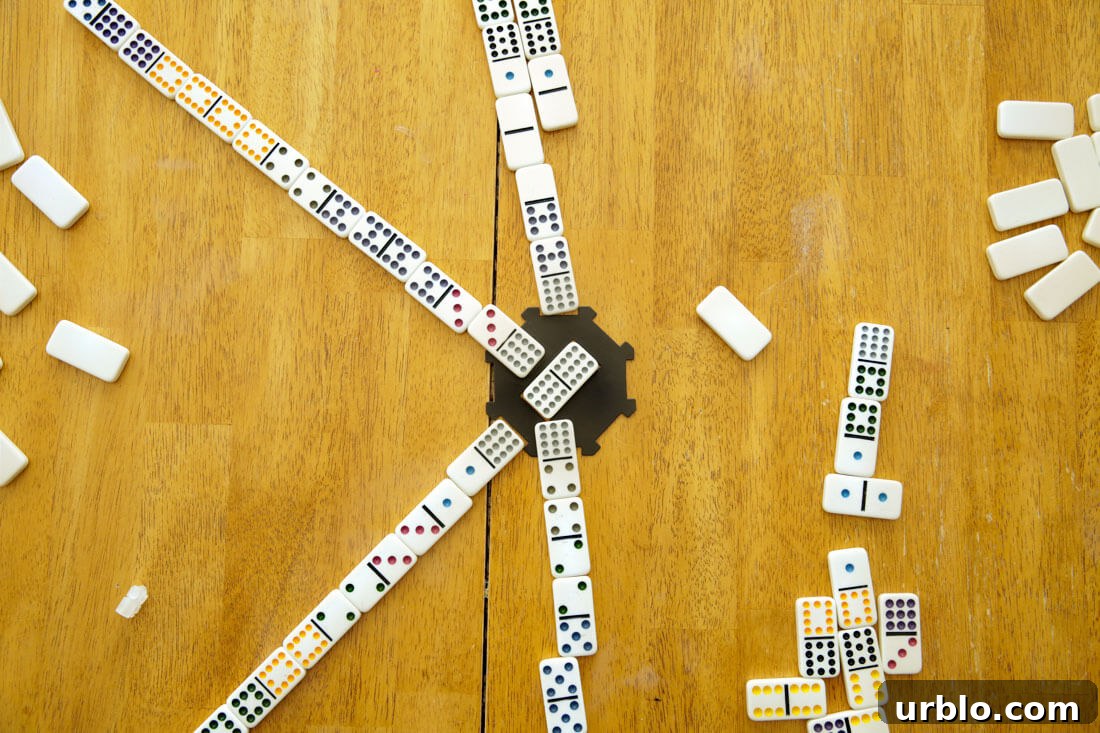
Turn all dominoes face down in the center and mix them to form the boneyard. Each player draws a starting hand based on the number of players: up to 4 players draw 15 tiles each, 5–6 players draw 12 each, and 7–8 players draw 10 each. Players arrange their tiles privately. Place the hub (center starting piece) in the middle and keep the remaining dominoes accessible as the boneyard. Each player has a slot on the hub to build their train.
START OF THE GAME
- The player with the double of the round (for a double-twelve set, the double-twelve) starts and places that double in the hub.
- The starting player then gets an extra turn.
- Play proceeds clockwise.
- If no one has the required starting double, players draw from the boneyard until the double is found.
HOW TO PLAY MEXICAN TRAIN
- Each player begins their train by placing a domino in their hub slot that matches the central double on one end.
- The matching end of the domino must point toward the hub; the other end shows the value that the train will extend from.
- On each turn a player may add one domino from their hand to any train available to them.
- If a player cannot play on any available train, they must draw one domino from the boneyard. If that domino can be played, the player plays it and the turn ends.
- If they still cannot play after drawing, they place a marker on the end of their train to indicate it is open to other players.
- When a player later plays on their own train, any marker they placed is removed.
- If a player plays a double, they immediately take another turn (and must follow any agreed double rules).
AVAILABLE TRAINS
On their turn, a player may play on:
- Their own train
- The Mexican Train (a public train started by a player by placing a tile matching the center double)
- Another player’s train, but only if that train has a marker showing it is open
ADDITIONAL RULES
- If a player cannot start their train on their first turn, they put up their marker; it stays until they successfully play on their train.
- If a player cannot play and the boneyard is empty, the player passes and must place a marker if one is not already present.
VARIATIONS ON DOUBLES
A common rule for doubles is that when a double is played at the end of any train, it must be satisfied—i.e., the next player must play a tile that continues that double. If they cannot satisfy the double, even after drawing, they place a marker on their train and play passes on.
HOW TO WIN
The round ends when a player plays all their dominoes. The winner of the round scores zero points; every other player scores the sum of the pips on their remaining dominoes. Play multiple rounds (commonly from double-twelve down to double-zero). After all rounds the player with the lowest total points wins.
HOW TO SCORE
- After a player goes out, everyone counts the pips on their remaining tiles to total their score for that round.
- Some play with a special rule: the double-zero tile counts as 50 points if left in hand when someone goes out (treat such special scoring only if your group agrees).
- When the final round uses double-zero as the starting tile, groups sometimes apply the higher penalty to the highest double remaining (agree on this ahead of time).
You can use a printable set of rules and a score sheet to keep track during play.
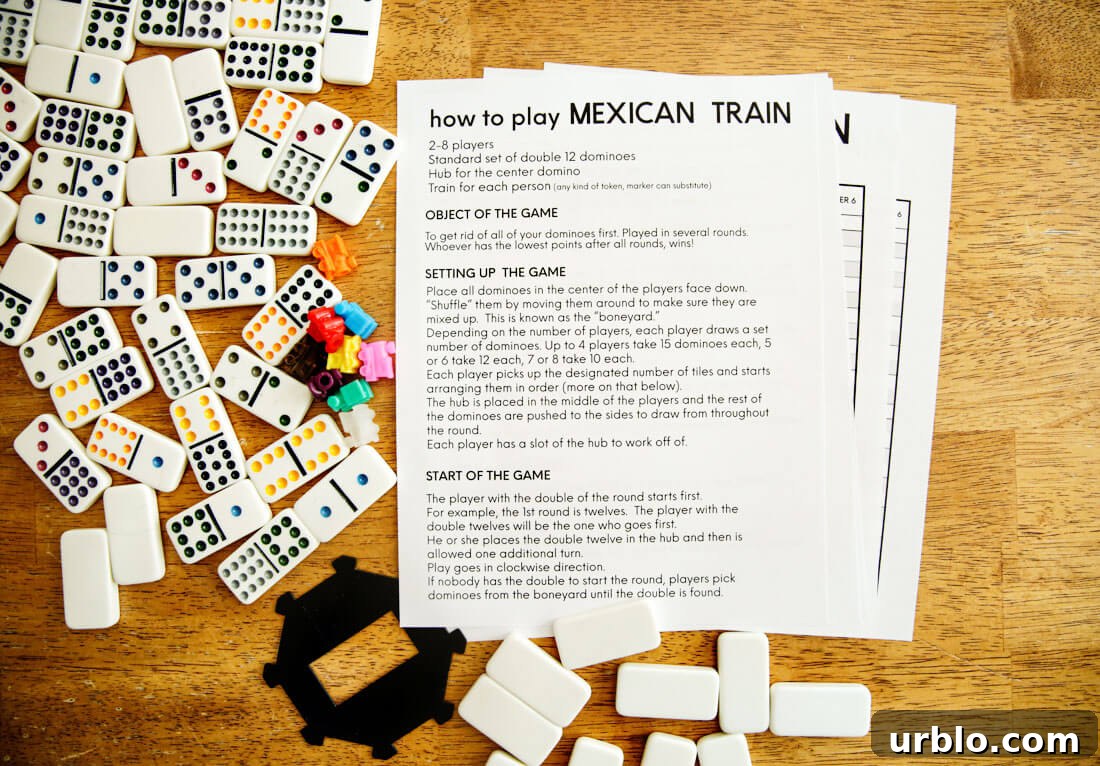
Download a set of game rules and a score sheet for personal use to make learning and scoring easier.