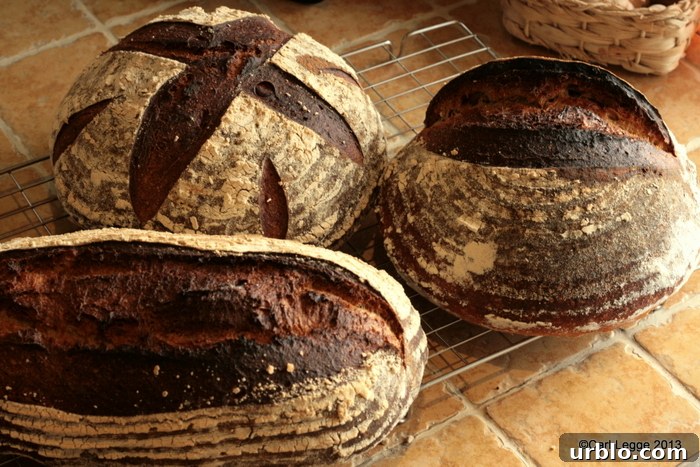
These three sourdough loaves were baked using a blend of Doves Farm English Wholegrain Wheat flour and Shipton Mill Organic White Strong Flour, producing a robust flavor and open crumb.
I prepared the dough the day before. After mixing, I performed four sets of folds at roughly one-hour intervals to build structure, then placed the dough in the refrigerator overnight to retard the fermentation. This slow, cool proof enhanced flavor and improved the dough’s handling.
On the morning of baking I removed the dough from the fridge to warm up while I had breakfast. Once slightly risen, I divided the mass into three portions and allowed them to rest for 30 minutes to relax the gluten for shaping. After shaping, I placed each loaf into a banneton for their final proof.
The loaves proved in a cool kitchen for about three hours before going into the oven. I baked them for 50 minutes, introducing steam at the start of baking to encourage oven spring and a crisp crust. The result was a well-colored crust, a pleasing crust-to-crumb ratio, and a nutty, wheaty aroma from the wholegrain blend.
Tips for reproducing these loaves:
- Use a strong white flour combined with wholegrain for balanced structure and flavor.
- Perform folds during the bulk fermentation rather than intensive kneading to develop strength.
- Retard the dough in the fridge overnight to deepen flavor and improve oven spring.
- Allow the shaped loaves to rest at room temperature until noticeably risen but not over-proofed—timing will vary by kitchen temperature.
- Introduce steam in the first 10–15 minutes of baking to maximize crust expansion and gloss.
Related posts you may enjoy:
- How to make sourdough bread simply
- Felin Ganol – Tybalt Flour: Sourdough Bread
- Sourdough bread with rye and linseed
- Felin Ganol Amaretto Flour: Sourdough Bread
These loaves showcase how a straightforward routine—folds, cold retard, gentle shaping and a careful final proof—can yield consistently excellent sourdough with depth of flavor and a satisfying texture.